Sleep signal guide
Sleep stages
Reviewed by Rest Coach Editorial | 2026-08-19
Direct answer
Direct answer
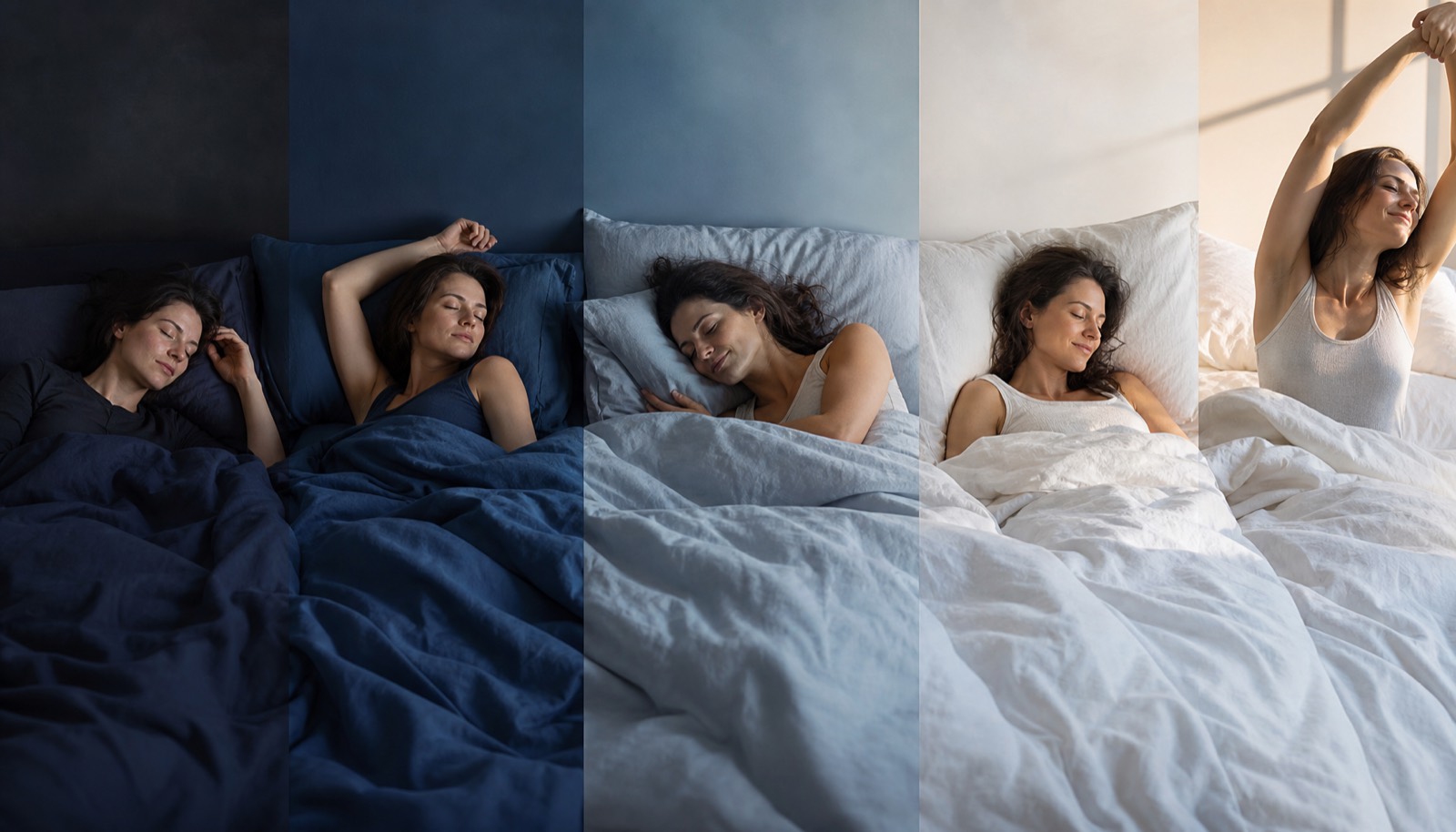
Sleep moves through non-REM and REM stages across repeated cycles. Consumer wearables estimate these stages from indirect signals, so trends can be useful while minute-by-minute labels remain approximate.
How to use it
- ✓Notice broad multi-night patterns
- ✓Understand why awakenings are more memorable later
- ✓Add context to a coaching conversation
What it cannot prove
- !Not a sleep-lab measurement
- !Algorithms differ by brand
- !A stage score should not overrule how you feel
What changes across a normal night
Sleep cycles through non-REM and REM stages. Deep non-REM sleep is usually concentrated earlier, while REM periods tend to lengthen later. Brief awakenings can occur between cycles without meaning the night failed.
Stage percentages change with age, schedule, illness, substances, medication, and ordinary night-to-night variation. A single pie chart is not a personality test.
How a wrist or ring makes the estimate
Clinical sleep staging uses brain waves, eye movements, muscle tone, breathing, and other signals. Consumer wearables usually infer stages from movement, heart rate, and related physiology. They can be useful for broad timing patterns but are less certain minute by minute.
Because algorithms differ, switching devices can create a new pattern even when your sleep has not meaningfully changed.
When stages are the wrong target
You cannot directly command more deep sleep tonight. Focus on enough sleep opportunity, a workable schedule, exercise, substance timing, and symptoms that may need evaluation. If the stage score itself is creating anxiety, hide it for a while.
Sources and further reading
- 1NINDS: Brain Basics, Understanding Sleep
Sleep stages, cycles, and regulation.
- 2de Zambotti M et al. Wearable sleep technology review
Capabilities and limitations of consumer sleep measurement.
Questions people ask next
How much deep sleep should I get?+
There is no single target that fits every age and person, and consumer estimates are imperfect. Daytime function and multi-night patterns matter more than one percentage.
Why do two trackers disagree about my stages?+
They may use different sensors, sampling windows, and algorithms. Compare trends within one system rather than treating either timeline as exact.